
When a Watch’s Condition Becomes Part of Its Story
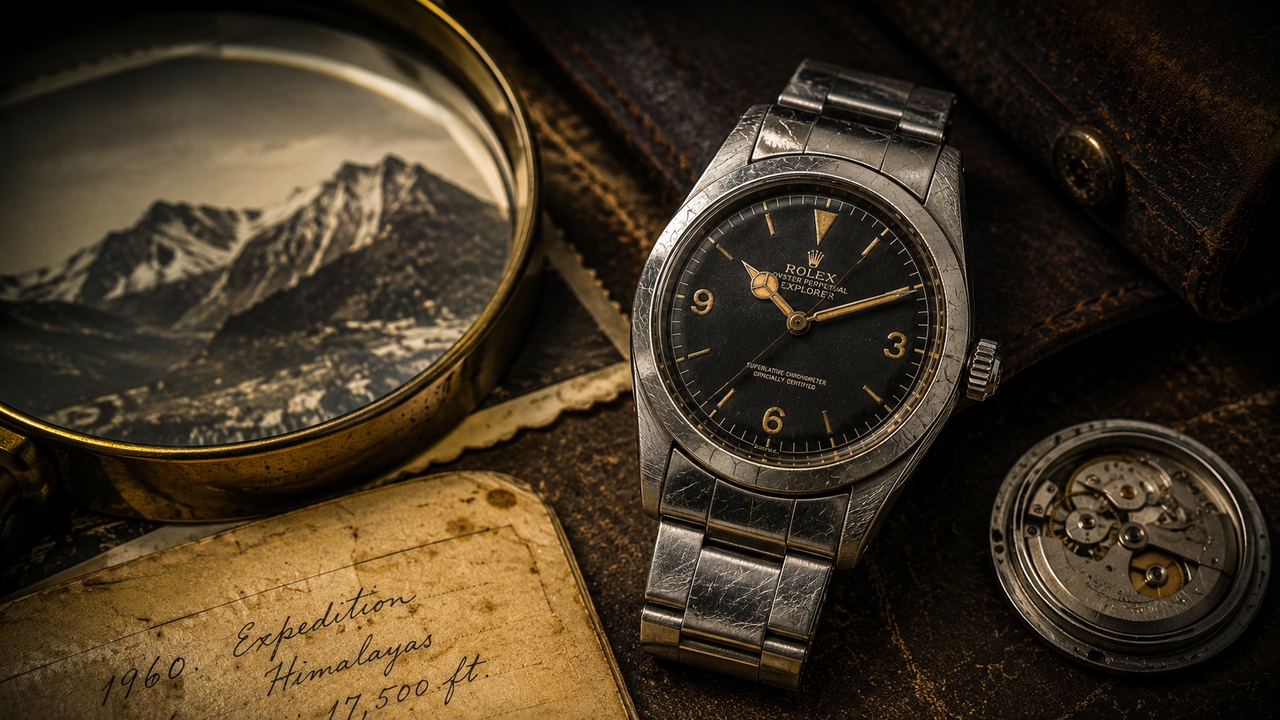
There is a point in collecting when the condition of a watch stops being a simple question of good or bad.
A watch can be worn, scratched, faded and slightly imperfect, yet those signs can tell us something important about its life. Another example of the same reference may look cleaner, but reveal considerably less about where it has been.
This is where condition becomes more complicated.
For collectors, originality and preservation matter. But so does the evidence left behind by time. The challenge is knowing when wear is simply deterioration and when it has become part of the character of the particular watch.
A Scratch Can Be More Than a Scratch
A watch that has spent decades on a wrist is unlikely to look exactly as it did when it left the manufacturer. The case may have picked up small marks, the bracelet may show wear around the links, the crystal may have been replaced during servicing and the dial may have changed subtly with age.
None of this automatically tells us whether a watch has been well cared for.
In some cases, wear is precisely what tells us that the watch was used as intended.
This is especially interesting with older pieces. A watch can carry decades of evidence in places that a specification sheet would never mention. The marks around a clasp, the softened edges of a case or the condition of a dial can reveal something about how the watch lived.
Of course, wear is not automatically desirable. There is a difference between honest use and damage, and understanding that difference requires looking closely.
Originality Makes the Question Harder
Condition becomes even more interesting when originality is involved.
A collector may encounter two watches from the same period. One looks remarkably clean, while the other shows obvious signs of age. The instinctive reaction might be to favour the cleaner example.
But what happened during those years?
Was the cleaner case carefully preserved from the beginning, or was it refinished during a later service? Is the dial original? Have the hands been replaced? Has the bracelet been changed?
The cleaner watch may still be the more desirable example. But appearance alone cannot answer the question.
This is why experienced collecting often involves looking beyond what immediately catches the eye. A watch's current condition is only one part of its history. The way it arrived there matters too.
Age Is Not the Same as Damage
This distinction is worth making because aged watches are sometimes discussed as though every sign of use should be celebrated.
That can go too far.
A cracked crystal is not necessarily attractive because it is old. A damaged movement does not become desirable simply because the damage is historic. A badly worn case may tell a story, but it may also have lost important original geometry.
Age and damage are different things.
So are patina and deterioration.
The collector's task is not to romanticise every imperfection. It is to understand what the imperfection tells us.
A naturally aged dial can be fascinating. A poorly maintained watch can simply be poorly maintained.
The two should not be confused.
When Wear Becomes Personal
There is another layer that has little to do with the technical condition of a watch.
Once a collector has lived with a piece for years, its marks can become familiar. A scratch acquired during a particular trip may be more meaningful to its owner than a perfectly preserved surface. A bracelet worn smooth through years of use can feel more appropriate than a replacement that looks new.
This is where condition becomes personal.
The same mark can mean nothing to one collector and everything to another.
There is no universal standard for emotional attachment to wear. That is one reason collecting can never be reduced entirely to condition reports.
Two people can look at the same watch and see different things.
One sees damage.
The other sees history.
The Temptation to Return a Watch to New
Restoration can make things more complicated still.
It’s easy to see why someone would want their old watch to look its absolute best. Cases can be refinished, dials can sometimes be cleaned up and parts can be replaced.
In some cases this work is necessary.
However restoring an old watch to look close to the way it did when it left the factory isn’t necessarily preservation.
You can’t undo material removed from a case. You can’t restore the evidence of wear removed from an original dial.
Restoration isn’t always a bad thing.
It just warrants consideration.
A watch can be in excellent condition without looking brand new. Sometimes being proudly “showing its age” is exactly what makes it fascinating.
Knowing What You Are Looking At
I think one of the most helpful ways to consider condition is to divorce appearance from history.
A watch can look worn and be original. It can be pristine and be heavily restored. It can have scratches and be incredibly well preserved when it matters.
The appearance tells you part of the story.
The paperwork, construction and little details tell you the rest of it.
This is why many collectors spend so much time obsessing over minutiae. The flow of the case, the dial and hands in relation to one another, the finish on the movement, the edges and evidence of past service.
All these clues fit together to form a bigger picture of what happened to a watch.
When Imperfection Becomes Evidence
The nicest old watches are sometimes the ones which are not the cleanest. Occasionally they’re the ones which allow you to see through to their past.
The faded dial, the worn bracelet and the marks on the case can become evidence that the watch has lived a real life. They do not make the watch valuable simply because they are imperfections.
They make it understandable.
That distinction matters.
A collector is not necessarily looking for damage. They are looking for honesty.
When condition remains closely connected to the watch's history, it becomes more than a description of its physical state. It becomes another part of the object itself.
Eventually, preserving an old watch does not always mean preserving the way it once looked.
Sometimes it means preserving the evidence of everything that happened afterwards.
Enjoyed this article?
Members of The Collectors Club have access to the full editorial archive, private introductions, and a community of serious collectors.
Apply for Membership