
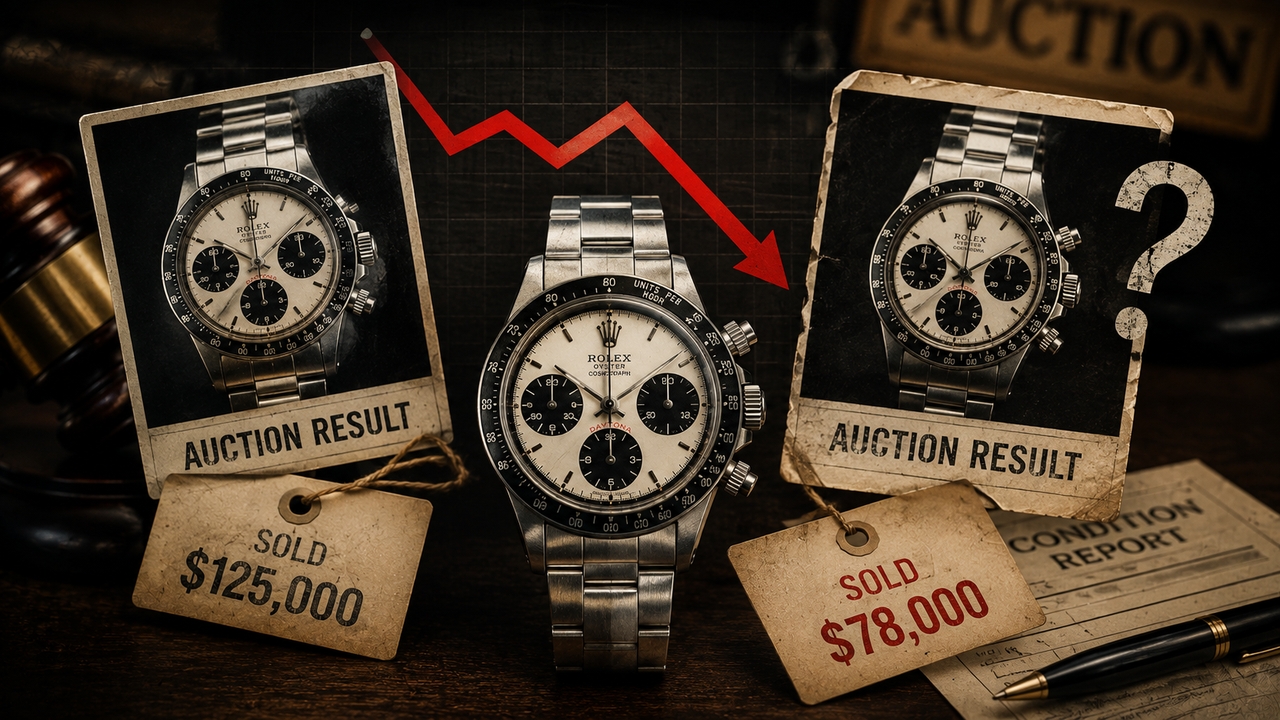
Let’s face it: there’s something a little telling about a watch that hits auction for the second time. The first auction starts the story. It arrives with its description, pictures and whatever provenance exists. Inspectors pore over it. Questions are raised. Ultimately, someone buys it. Years later, it shows up at auction again.
Perhaps not much has changed about the watch.
But our perspective of it might have.
The second auction plants a question in our mind about the watch’s journey:
Why is it here again?
Maybe the previous owner just moved on.
Maybe the collection lost interest. Maybe the collector’s financial situation changed. Maybe the watch was never really meant to be part of the collection.
Selling watches is nothing to be ashamed of.
However you slice it, a watch that hits auction twice now has history we can refer to.
A public record of it being seen, purchased and offered for sale again.
Suddenly, the auction history becomes part of the object.
This can be fascinating with watches that have an interesting history. A watch that keeps showing up at auction can start to build a legacy all its own. Especially when compared to another watch that quietly changed hands dozens of times privately.
History Begins to Repeat Itself
An auction result is just a snapshot in time.
When the same watch appears for a second time, we are given another snapshot to compare.
Both sets of inspectors can now study the condition reports, the pictures and the previous description. Did the watch change at all between the two appearances? Was the case polished? Was the dial restored? Was the bracelet replaced?
Sometimes, these follow-up auctions can provide insight.
Other times, they cause more confusion.
This new information won’t necessarily make a watch more or less attractive to buyers. However, uncertainty can raise questions about a watch. If previous owners provide solid documentation of what they owned and when, that can be valuable information in itself.
There is a difference between a watch with an established history and a watch with a mysterious one.
“I can see this watch being sold by X, Y and Z collections.”
versus
“Whoa, the description keeps changing every time it’s sold.”
Value Isn’t Always Cut and Dried
We like to think of value as an absolute.
That every watch should have one “correct” number that it deserves based on certain criteria.
Condition. Originality. Provenance. Completeness. Reference. These all play a part in how much someone will pay for a watch.
But so does buyer confidence.
Someone buying a watch wants to know as much as they can about what they’re getting.
The second auction can help solidify that confidence or destroy it, based on the prior history of the watch.
Has it been consistent, or have large details changed between auctions? If the watch comes back and is essentially the same as before, its second auction can simply be another piece of the story.
If, however, major details suddenly change from one auction to the next, the watch suddenly has something most don’t.
A paper trail.
When a Watch Gets Interesting
In some cases, a watch can actually gain interest because it keeps popping up.
It’s been through more hands and more trends than others.
You start looking at the watch as less of a manufactured product. More as a watch that has lived multiple lives in collectors’ homes.
There is something oddly endearing about watching a watch’s journey through the market.
Again, the second auction isn’t always bad.
What matters is the story told between the two auctions.
If a watch returns to market with its history intact, it’s usually a safer proposition.
If it returns with questions, you might want to approach it with a little more scrutiny.
Just remember that when the same watch pops up twice, it stops being just one watch.
It becomes one watch with history.