
What “Full Set” Actually Means, and Where the Term Gets Misused
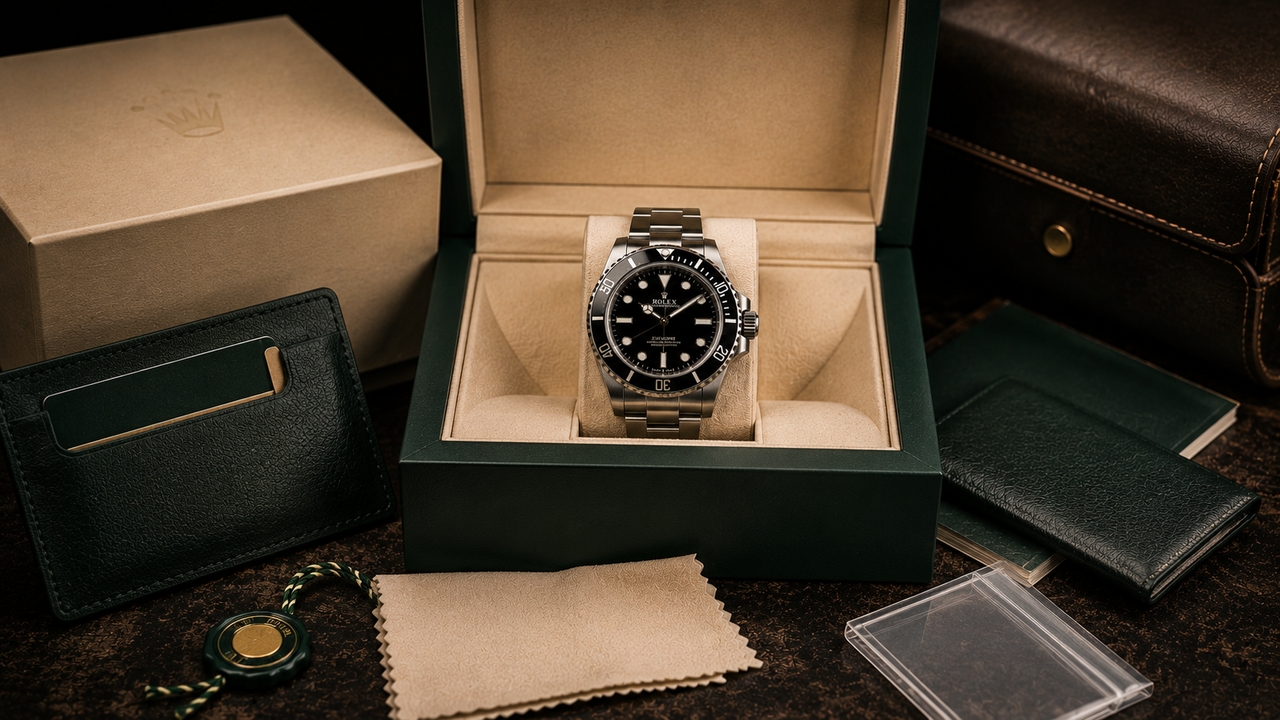
When was the last time you came across a watch that wasn’t being advertised as part of a “full set”? Or at least sold with as many accessories as possible?
Whether you’re looking at vintage watches online or perusing catalogues at a local dealer, “full set” seems to be everywhere these days. But how often does it actually mean what you think it means?
Let’s start with the basics.
What “Full Set” Means
Buyers should expect some variation when a watch is listed as a “full set.”
Simply put, a watch that’s being sold as part of a full set can contain anywhere from its original box and papers to every accessory and piece of documentation ever produced for that particular reference.
Sometimes, “full set” is used accurately. Other times, it’s being used rather generously.
Why Should You Care?
A watch’s “fullness” is important to collectors because the items that come with a watch can be an extension of its history. Boxes, papers, booklets and other accessories can establish where a watch was purchased, how it was supplied when new and how that history has been curated over time.
But just like any other part of a watch’s past, provenance shouldn’t be exaggerated. Accessories shouldn’t be allowed to tell a history that can’t be supported by evidence.
Where Is All the Flexibility Around “Full Set”?
“Full set” leaves a lot of room for interpretation.
When applied to watches, “full set” has no universal definition. What came with a watch when it was sold new will vary between manufacturers, decades and even markets. A watch from the 1960s shouldn’t be held to the same standards as a modern watch simply because more accessories have become common over time.
That said, “full set” should at least imply that a watch comes with the original items that were included with it when it was sold new. For most watches, that can mean its original box, warranty card or certificate, instruction booklet, swing tags and any other material included by the manufacturer when it left the factory.
What do we mean by “original”? The certificates came with the watches. The boxes, however, did not.
If a seller is describing a watch as part of a full set, they should be precise about what exactly makes it full.
A watch can be complete with its original box and papers without necessarily being considered a full set. Conversely, a watch may not have its original box but could still have all of the documentation that matters. Neither situation necessarily makes a watch incomplete.
Clarification is key.
Original boxes aren’t always enough to make a “full set.”
The Problem With “Full Set”
The issue begins when “full set” is used as a hyper-technical specification.
“This watch is sold with its original box and papers, but that doesn’t make it a full set.”
Too many sellers allow “full set” to imply that a watch comes with every piece of material ever produced for that reference. The reality is that watches can be missing items and still be considered complete by collectors.
A “full set” doesn’t necessarily mean everything.
Where “Full Set” Gets a Little Too Stretchy
If you see “full set” used as a catch-all description of completeness, proceed with caution.
Sometimes, sellers use “full set” to mean absolutely everything. A watch may be described as part of a full set while giving no further details about what’s included.
Does that mean the watch doesn’t have its original sale paperwork? Did the seller simply forget to mention that the wire tag is a replacement? There’s no way of knowing until more information is provided.
When “full set” is used as a blanket statement, it’s really the customer who has to fill in the blanks.
Did “Full Set” Really Matter?
A watch with glowing provenance can be just as exciting as one being sold as a “full set.”
The term “full set” can create unrealistic expectations when it comes to older watches. Since band kits, warranty cards and packaging designs have changed over the years, a “full set” from the past may not match modern expectations.
This Messer soldiering watch was sold with every item except the box. Is it still worth owning because of the documentation?
Absolutely.
But here’s the real kicker: a “full set” doesn’t automatically make a watch complete.
One watch may be sold with an original box and every accessory known to man, but have gaps in its ownership history. Another watch may come with a replacement band and no warranty card, but have rock-solid provenance.
Connect With the Past
A watch should always be judged by the history that’s attached to it. If a full set of accessories helps to tell that story, so much the better. But those extras shouldn’t be treated as a necessity.
After all, what’s really full about collecting watches anyway?
Collectors seek completeness of knowledge.
Enjoyed this article?
Members of The Collectors Club have access to the full editorial archive, private introductions, and a community of serious collectors.
Apply for Membership