
The Watch You Stop Noticing, and Why That Might Be a Good Thing
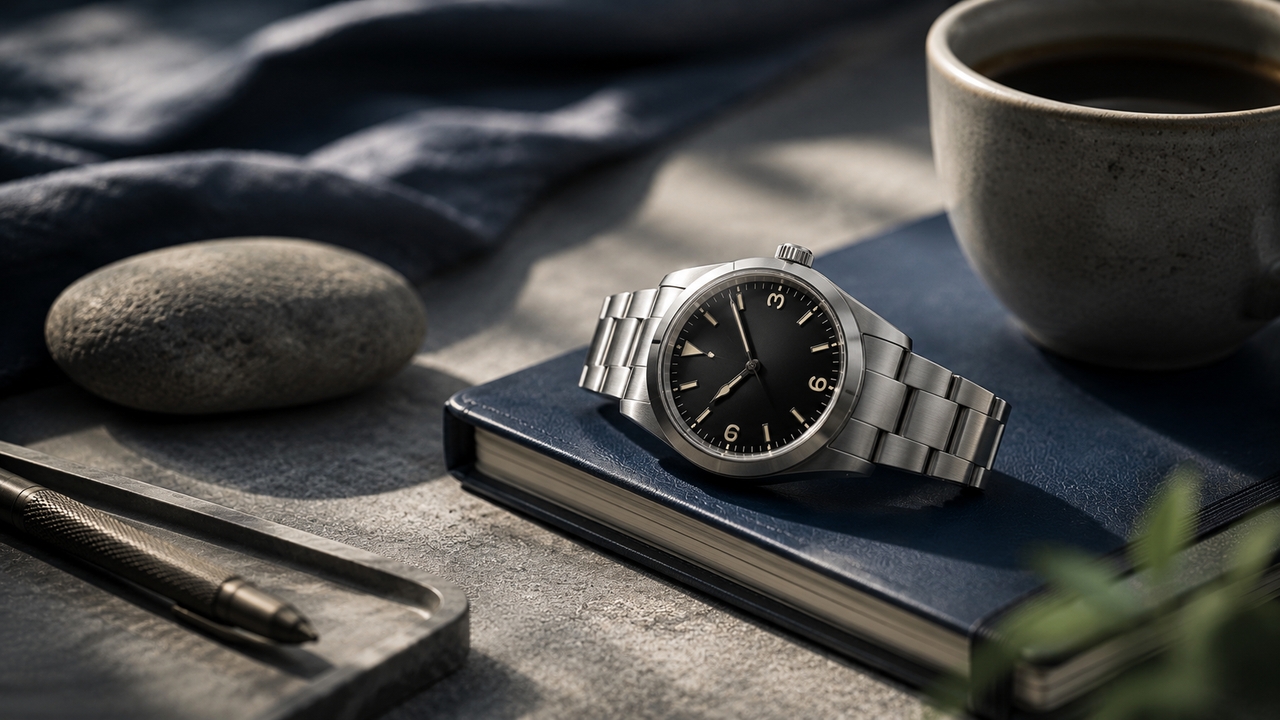
There comes a point with many watches where you stop noticing them.. Not because you have grown tired of it. Quite the opposite, sometimes. The watch has simply become so familiar that you no longer think about choosing it. It is already on the wrist before the rest of the day has properly begun.
That can feel like a strange outcome for a collector. We spend so much time studying watches before buying them. We notice the dial, the hands, the case, the movement and all the small details that made us want the watch in the first place. Then, after enough time, those details can become almost invisible.
The watch becomes part of the routine.
Familiarity Changes the Relationship
New watches demand attention.
There’s the first morning you put one on and find yourself staring down at your wrist. You find yourself looking at how the light catches the dial. You glance at the time more often than you probably need to. You twist your wrist around to see how that complicated case looks from a different angle.
That feeling eventually fades.
It has to.
If every watch continued to demand that level of attention, wearing one would become exhausting.
The interesting thing is what comes afterwards.
A familiar watch does not need to announce itself every morning. You know how it looks on your wrist. You know how it feels when you put it on. You know whether the crowns sticks out too far when your sleeves are rolled up. You know how long it takes to buckle your waist band when you’re wearing a dress watch.
You stop thinking about those things.
That does not necessarily mean the watch has become less important. It may mean that it has become easier to live with.
The Watches That Become Invisible
Collectors often notice which watches receive the most attention.
A new acquisition is photographed. A particularly unusual reference gets discussed. A complicated movement invites another look through a loupe.
The everyday watch can receive much less attention.
It sits in the collection quietly and gets worn far more often than the pieces that attract conversation.
There is something revealing about that.
A watch that is constantly being admired may be interesting. A watch that you repeatedly choose without thinking may have become something more personal.
The distinction is similar to the difference between a favourite chair and a beautiful piece of furniture.
The beautiful object catches your eye.
The familiar one is where you sit.
Why Collectors Sometimes Miss This
Collecting encourages comparison.
Every new watch gives you something to evaluate against the others. You compare cases, movements, dials, proportions and history. You think about what makes one piece different from another.
That is useful.
But it can also make familiarity seem less interesting.
A watch that has been in the collection for years may no longer provide the excitement of discovery. There is nothing left to uncover. You already know its details.
Yet that may be precisely why it has lasted.
The absence of novelty can be a sign that the relationship has moved beyond novelty.
You don't need to rediscover a watch every morning.
You just need to want to wear it.
When the Watch Becomes Part of Daily Life
The most revealing test is often what happens when the watch isn't available.
If it is being serviced, left at home during travel or temporarily stored somewhere else, you may find yourself noticing its absence.
The wrist feels different.
You reach for another watch and immediately notice that something isn't quite the same.
The replacement may be technically better in some respect. It may be more unusual or more interesting to look at.
Still, you miss the familiar one.
That tells you something.
The watch has stopped being an object you actively assess and become part of your routine. Its value is no longer entirely connected to the qualities that attracted you to it originally.
It has accumulated familiarity.
And familiarity, in collecting, can be remarkably powerful.
Not Every Important Watch Needs to Excite You
There is a temptation to think that every watch in a collection should continue to generate excitement.
That is an impossible standard.
A collection can contain watches that fulfil different roles. Some are there because of their historical significance. Some because of their technical qualities. Others because they are simply enjoyable to wear.
The last category is easy to underestimate.
A watch does not have to surprise you every time you look at it.
Sometimes its greatest quality is that you never have to think about whether you want it on your wrist.
You already know.
That is particularly interesting as a collection matures. The collector may become less interested in novelty and more interested in familiarity, proportion and comfort. The question becomes less about what is new and more about what continues to feel right.
The Quietest Watches Can Have the Strongest Hold
Maybe that’s why our neglected watches deserve another look.
Perhaps they aren’t the watches we speak about most.
Maybe they won’t be the ones that garner the most attention from our fellow collectors.
They may not even be the first watches we name when asked about our favourites.
But grab the box next time you’re running late in the morning and see which one you reach for.
You can’t program that instinct.
Sometimes a watch can be important in your life without demanding the spotlight. Quite the contrary, maybe it’s the reason it’s important that you ignore it.
After some time, the watch simply becomes a part of your everyday life.
And maybe that right there is the greatest compliment you can give a watch.
Not that it still intrigues you.
But that you continue to pick it, despite no longer knowing why.
Enjoyed this article?
Members of The Collectors Club have access to the full editorial archive, private introductions, and a community of serious collectors.
Apply for Membership