
The Ethics of Restoring a Piece with Documented History
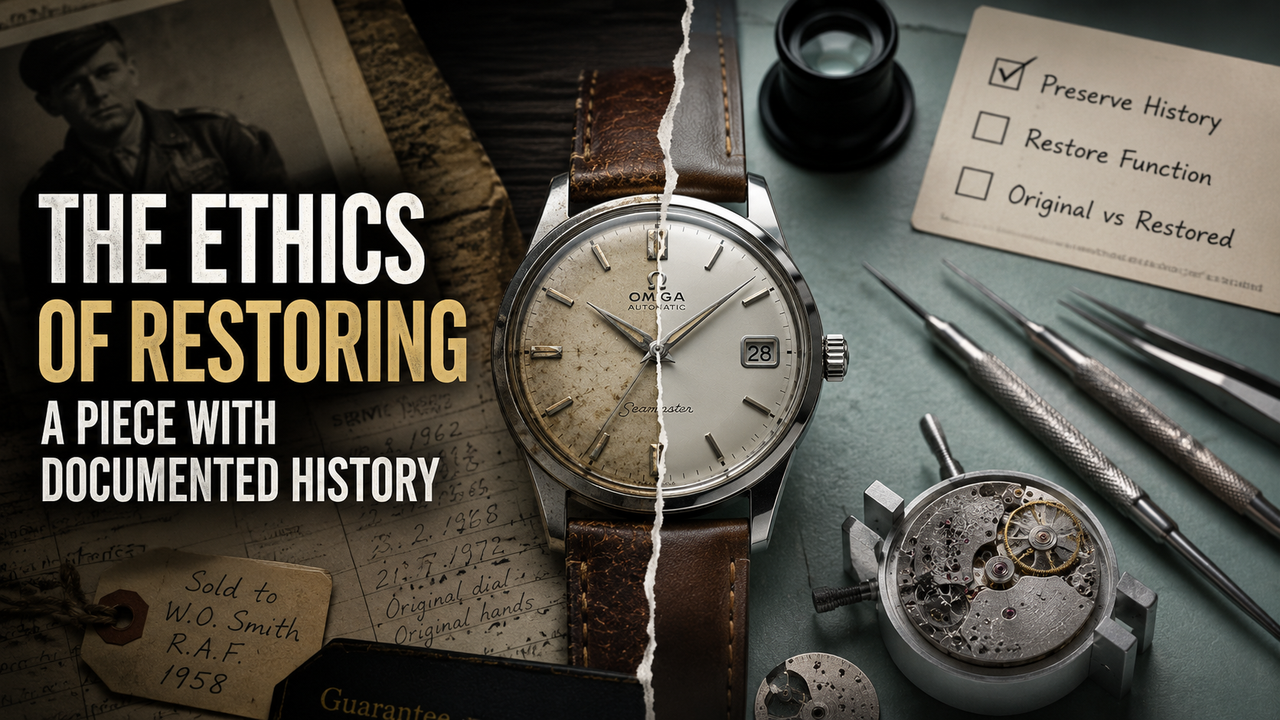
It’s easy to talk about restoration until you have a watch with history that you want to preserve. Replace a broken crystal. Refinish a scratched case. Clean up a worn dial. Of course, we can rebuild and repair to bring a vintage timepiece back to life. But what if the wear on the watch is part of the story you want to preserve?
That’s when restoration gets tricky.
Are we restoring the watch, or are we altering it?
The easy answer is to restore the watch to how it should look.
But should all watches look how they did when they left the factory?
A vintage watch that has been worn for decades will change as it ages. The metal case will develop scratches. Dials will fade or develop tonal shifts. Hands can lose their finish. Bracelets will develop a patina from years of wear.
Often, these changes are due to neglect. But they can also be evidence of how the watch was cared for.
By restoring these signs of wear, we can sometimes strip the watch of its past.
When a watch has documented history, that thinking needs to change.
A watch with provenance, whether that means photographs, service records or known ownership, changes the philosophical approach to restoration.
A known watch is not an anonymous vintage timepiece.
It carries with it the history of its previous owners.
Keeping a Watch Original Isn’t Always Keeping It Pristine
Our modern tendency is to believe a well-restored watch should look perfect. Magazine-cover perfect.
But is that watch with the refinished case really telling us more about the watch than the worn one it replaced?
Would cleaning up that dial really reveal more about the watch, or just how it looked when new?
Don’t get me wrong. Some restoration is necessary to preserve a watch.
Parts that prevent the watch from functioning correctly should probably be replaced. Movements might need replacement parts to keep them running. Crystals should be changed when broken. Damaged crowns may need to be replaced to protect the movement.
Once the watch is usable, we enter the grey area of restoration.
How much is too much?
Don’t Forget the Journey
Good documentation allows the restorer to be transparent about their work.
Photographs taken before restoration can catalogue the condition of the watch beforehand. Service records can detail what has already been replaced. Notes can highlight which parts are original.
This information is just as much a part of the watch’s story as what is actually done to it.
Detailed notes and photographic documentation protect the next owner.
An extensively restored watch isn’t necessarily a problem if its restoration has been properly documented for future owners. Someone throwing an aged dial on a DeBugator and calling it vintage isn’t helping anyone.
In most cases, you won’t be able to tell the difference between an honest restoration and a forgery just by looking at the watch.
But years down the road, when someone else inherits that watch, they will be able to see exactly what happened to it.
In some cases, the best restoration is the least amount of restoration.
We can spend all day talking about restoring watches with historical significance.
But there are just as many watches out there that don’t need restoring at all.
Too often, we see watches with minor damage restored to near-factory condition. I’ve seen some watch guys screw up perfectly good vintage watches by over-restoring them.
A few scratches here or a faded dial there doesn’t hurt anything.
Sometimes, that worn case is the reason you fell in love with the watch.
As restoration professionals, it can be difficult to know when to stop.
I’m not suggesting we should never restore a watch to its original appearance. There’s a time and place for that.
But before we do, we should ask ourselves whether returning the watch to new is the right thing for that particular watch.
It takes patience.
And maybe a little humility.
Remember, you are not writing this watch’s history.
You are merely continuing it.
Enjoyed this article?
Members of The Collectors Club have access to the full editorial archive, private introductions, and a community of serious collectors.
Apply for Membership